
Scope Creep, 2026-07-14
This causes multiple problems.
A PSA: I’m pleased to announce that the SOW Reading Group is reading Brian Potter’s The Origins of Efficiency as our next book! We’ll be discussing it on Thursdays at noon ET from now through August, with a group conversation with Brian when we finish the book. You can join us by starting a paid subscription here, then emailing me directly for the details :)
(As a side note, it’s hard to believe that it was five years ago, but Brian Potter wrote one of the most interesting and thought-provoking essays I’ve ever had the pleasure of editing. The piece, which is about the every-twenty-year practice of completely rebuilding the Ise Jingu temple, holds up fantastically today :)
Some additional notes:
- I really, really enjoyed this essay about a summer spent in Alaska working as a Fish and Wildlife Technician II, sampling and tracking data on the salmon harvest for the state’s Department of Fish and Game. The technical detail in the essay is extensive, and the way it’s framed — alongside the writer’s anxieties, and urges, and sensory experiences — makes it both palatable and also deeply enlightening.
- Banana Ball is not baseball. It looks like baseball — there is a diamond, and batters and pitchers and fielders — and in a broad cultural sense it functions like baseball, bringing people together to root for or against a couple loads’ worth of increasingly dirty laundry. But Banana Ball has its own rules, and its own all-yellow-clad owner-and-spokesman, and its own YouTube channel, where you can find all manner of impressive trick shots being performed during the otherwise normal-ish course of play.
- I bought a copy of Overcoming Gravity recently, and am now trying to work on my planche, and belly-to-the-wall handstands. In very vaguely related news, I enjoyed this recent episode of the New Yorker’s Fiction podcast, in which the idea of “being good at having a body” was briefly discussed.
A babysitter threw our ice cream scoop into the dishwasher recently. This causes multiple problems. First, the scoop is made mostly of raw, polished aluminum, which had a nice shine on it when new but became distastefully tarnished during its two alkaline hours in the belly of the Bosch. Second, the ice cream scoop’s handle is actually a hollow, sealed vessel, which is full of a liquid, and is plugged with a “snap plug” that seals the liquid inside. When placed in the dishwasher and heated, the liquid expands, increasing pressure inside the handle and potentially damaging the plug.
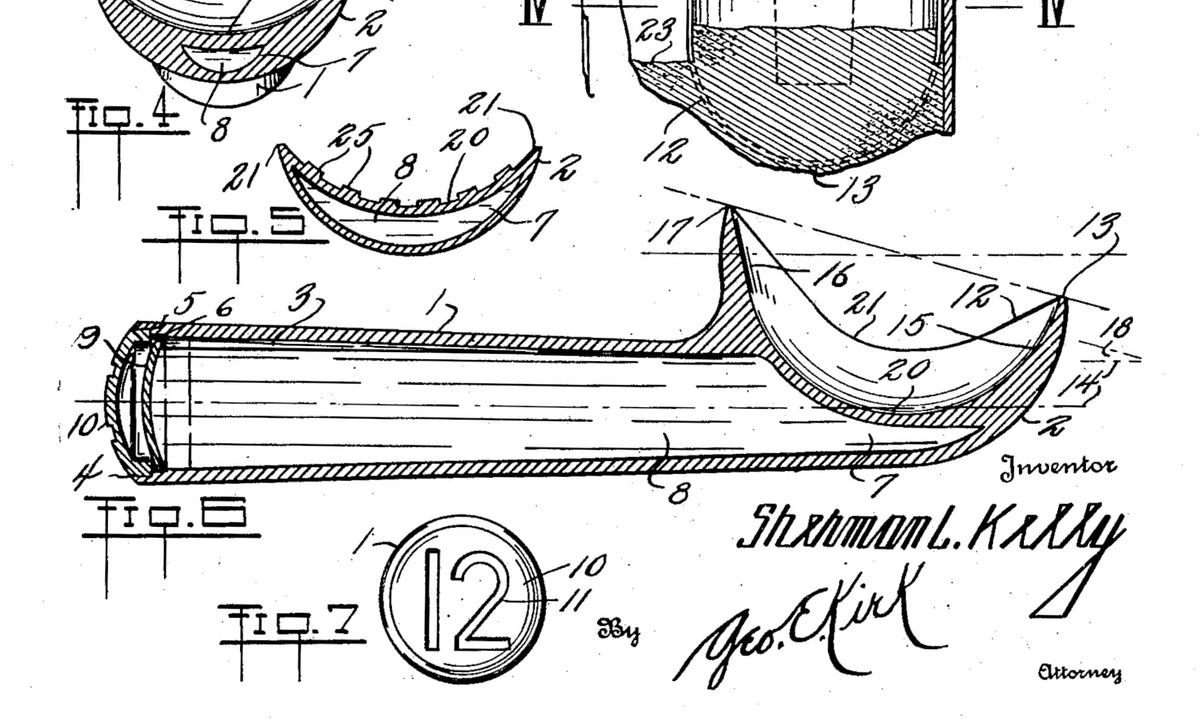
Here’s the original patent for this variety of liquid-filled ice cream scoop. The scoop’s handle “may be partially filled with liquid, such as alcohol or even water; the liquid being one preferably having a high heat conductivity.” Serious Eats says these kinds of scoops are filled with food-safe mineral oils; other, similar scoops are filled with eutectics.
Eutectics. I knew this word before I bought this particular ice cream scoop, but I’m not sure I had really thought through what it meant. Eutectics are a class of homogeneous mixtures; they’re made of a mix of different stuff, but they look and act like a single, smooth material. Eutectics have a unique property, though, which is that they freeze (and melt) all at once, and at temperatures which are lower than their undiluted constituents do.
Imagine this: you have two pure substances, like water and ethanol. In everyday conditions water freezes at 0°C, and ethanol freezes around -114°C, but if you mix them in the right proportions then the combined freezing point of the mixture is lower than either of its constituents: -117°C. What this means is that the entire mixture freezes into a crystalline lattice all at once, when the temperature reaches -117°C.
On the other hand, non-eutectic mixtures freeze partially, in stages, as their components’ freezing points are reached. We call the temperature below which a non-eutectic is fully solid its solidus temperature. Between the solidus and the liquidus, the non-eutectic is a slush, partially solid and partially liquid. Then, when a non-eutectic reaches its liquidus temperature, the entire mixture melts. Lower the temperature again and the entire thing happens in reverse, the liquid solidifying partly when below the liquidus temperature and then freezing solid at its solidus.
For practical purposes, though, non-eutectics can seem more or less solid at temperatures well above the solidus. Take vodka, which is also made of water and ethanol, but whose proportions don’t result in eutecticity. Put a bottle of vodka in the freezer and lower the temperature, and you’ll notice ice crystals forming a little below -20°C — the liquidus point of eighty-proof vodka. The ice crystals will be made of (nearly) pure water, and as the temperature drops further, and more water freezes out of the mixture, the remaining liquid becomes more and more alcoholic. Eventually, around -27°C, a bottle of vodka will act more or less solid, the highly concentrated ethanol-water mixture becoming trapped in a dense block of ice.
But a chemist might look at the thermometer and insist that the vodka isn’t frozen solid until it reaches -123°C — at which point the ethanol-water portion will have exceeded a hundred and eighty proof. An entrepreneur might watch this happen and see an opportunity: Buy low-ABV booze, like hard apple cider, and freeze it down to -30°C, and separate the ice from the remaining liquid, and the liquid will be in the range of eighty proof. We call this process fractional freezing or freeze distillation, and it’s how applejack, among other spirits, is made.
Apropos of my lemonade recipe, shared recently, it felt appropriate to mention that lemon juice provides mostly sweet and sour flavors; it’s relatively low in the aromatic notes that identify something as lemony. This is why my lemonade recipe is based primarily on the zest, which contains a variety of highly aromatic terpenes. According to Harold McGee’s On Food and Cooking, these include limonene, pinene, terpinene, neral/geranial, linalool, and decanal/octenol. Also interesting, from page 373:
The taste of citrus fruits is created by a handful of substances, including citric acid (so named because it is typical of the family), sugars, and certain bitter phenolic compounds, which are usually concentrated in the albedo and peel. Citrus fruits are surprisingly rich in the savory amino acid glutamate, sometimes rivaling the tomato (oranges reach 70 milligrams per 100 grams, grapefruits 250)...Usually the blossom end of the fruit contains both more acid and more sugars, and so has a more intense taste than the stem end; neighboring segments can also vary significantly in taste.
Then, on page 377:
Lemons may have originated as a two-step hybrid, the first arising in the area of northwest India and Pakistan, the second in the Middle East. Lemons arrived in the Mediterranean around 100 CE, were planted in orchards in Moorish Spain by 400, and are now mainly cultivated in sub-tropical regions...There are many varieties of true lemon, and also a couple of further hybrids. The large, coarse Ponderosa variety is probably a lemon-citron cross, and the Meyer lemon, a thin-skinned, less acid version brought to California in the 20th century, is probably a cross between the lemon and either orange or mandarin, with a distinctive flavor due in part to a thyme note (from thymol). Lemons are generally “cured” for better shelf life; they’re picked green and held in controlled conditions for several weeks, where their skin yellows, thins, and develops a waxy surface, and the juice vesicles enlarge.
Thanks to SOW's paid subscribers for making this newsletter possible. If you liked anything here, and want to support my work, you can do so by forwarding to a friend — or starting a paid subscription for yourself.