
An Incomplete Accounting of What I’m Reading
Shout out to everyone whose books are on my coffee table
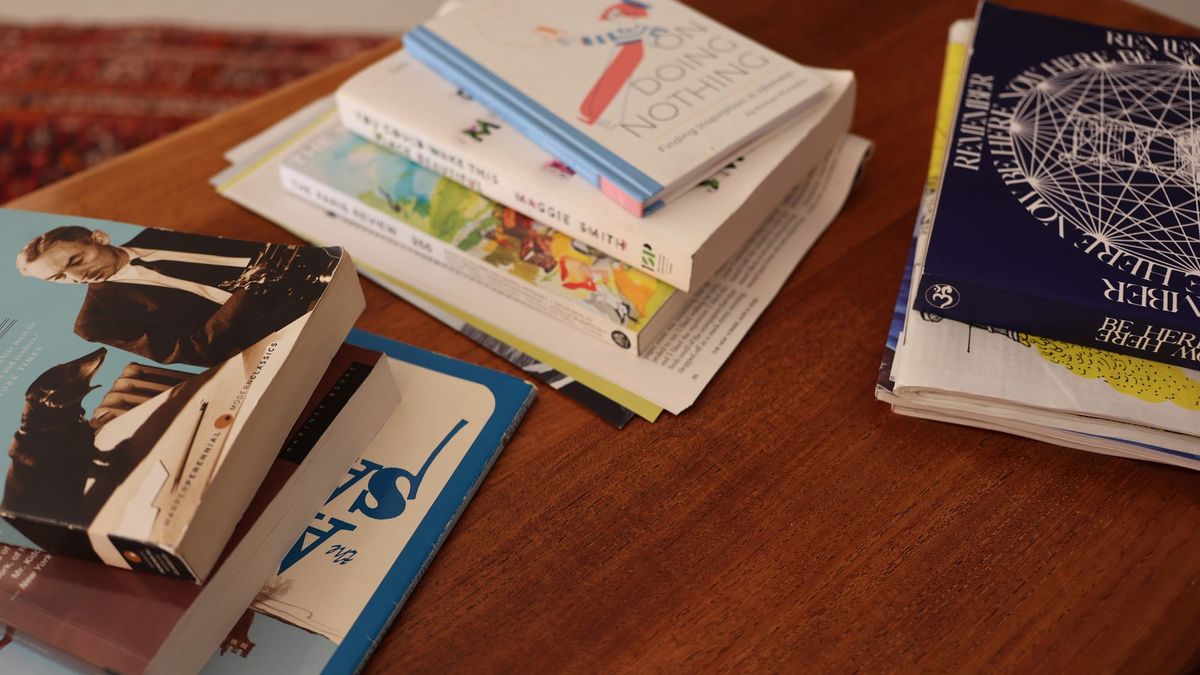
My coffee table is kind of a mess, the number of books on it having become ostentatious over the past couple of months. Of course there’s House, which I’m enjoying reading with the SOW Reading Group, but that’s just the tip. Indeed there are dozens of texts next to, underneath, and on top of my paperback copy of House, each with a bookmark sticking out to indicate my meandering progress. I am trying the ideas in each of them out, taking little tastes, and seeing how they affect my thinking, how they contextualize my understanding of the world. Looking around me now, I see:
- Maggie Smith’s memoir, You Could Make This Place Beautiful, which chronicles both her separation and her rise to poetic prominence
- A stack of technical explainers. The stack began with David Macaulay’s The Way Things Work, which I read with my dad as a kid and have always looked for opportunities to pull off of the shelf. I pulled it off the shelf a few weeks ago to answer one of the most delightful requests my six-year-old has ever made of me. She made it while we were lying on my bed, in the moments before what was supposed to have been bedtime, and as she finished making the request she turned and stared into my eyes. The request was: “I want to talk about how bikes work.”
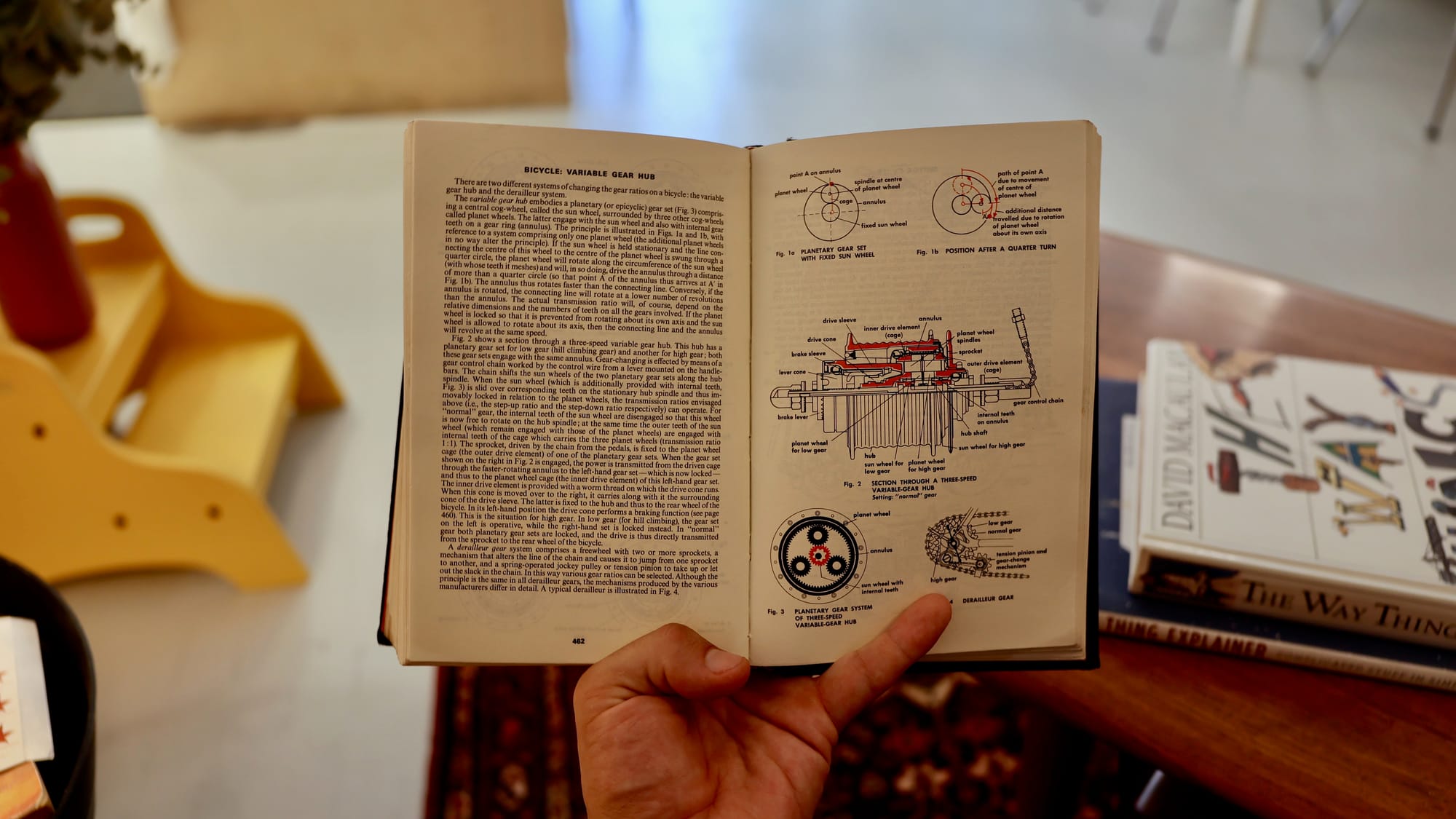
Of course we got out of bed, and went downstairs, and consulted both The Way Things Work and also multiple bicycles, one of which hung in the front hall and three or four of which were stored in the basement. As I pulled The Way Things Work off of the shelf I also retrieved Randall Munroe’s Thing Explainer, whose title I later overheard the same six-year-old chanting in a sing-songy way, but which we have yet to truly examine together. Lastly, I asked the six-year-old to retrieve my copy of Simon and Schuster’s 1967 The Way Things Work, Vol. 1, and we put this text on the stack too. This TWTW Vol. 1 is much less playful than either the Macaulay or the Munroe, and it has not been referred to in our bicycle discussions to date, but does contain a rather beautiful cutaway diagram of an internally-geared hub:
- John Steinbeck’s The Red Pony, which was given to me when my mom died and which I’ve read a few times since
- Tse Wei Lim’s Little Perfections, which the SOW Reading Group finished recently and which was a delight to read and discuss
- Dave Eggers’ The Eyes and The Impossible, which my kids loved; Dave Eggers’ A Heartbreaking Work of Staggering Genius, which I loved when I was younger and which I still find captivating
- Kate DiCamillo’s The Miraculous Journey of Edward Tulane, which my kids also loved, and Elizabeth Enright’s The Saturdays, which we’re currently reading thanks to Leah Libresco’s excellent recommendation
- The most recent issue of The Paris Review; the most recent issue of New England Review; the most recent issue of the New York Review of Architecture; the most recent issue of Granta
- Andrew Tarlow et al’s Diner: Day For Night, which is ostensibly a cookbook but for me functions as some sort of parasocial family photo album
- Not on my table per se, but recently I listened to and very much enjoyed Michael Pollan’s new book about consciousness. I also listened to and very much enjoyed Adam Ross’s novel, Playworld.
- A copy of Be Here Now, and a copy of On Doing Nothing. Each time I consider picking one of these up, I think that instead maybe I should turn the music off and just sit here, listening to the world go by, for a moment… and then I think of the quote from On Doing Nothing which convinced me to purchase a copy, and which I received from Craighton Berman:
Artistic delay is resisting the impulse to explore an idea fully at its birth, instead allowing it to live for a while in the greenhouse of the mind, where it may mature and corrupt, grow into something new, or die and fertilize the soil.
- A copy of Jan Adkins’ The Art and Industry of Sandcastles, which I believe is out of print and which I brought to the beach recently and attempted to read to a couple of six-year-olds, who only listened for a minute before drifting back into play.
But recently the thing I’ve found myself carrying around most is a copy of Essays of E.B. White. White, who is perhaps most well-known for having written Charlotte’s Web, produced scores of essays during his career at The New Yorker and elsewhere. I read Charlotte’s Web with my kids a few months ago, but was mostly ignorant of White’s role as essayist emeritus until two people — Kris first, then Nick — mentioned him in reference to my own writing. So I picked up a copy of Essays, and was immediately struck with this quote:
The essayist is a self-liberated man, sustained by the childish belief that everything he thinks about, everything that happens to him, is of general interest. He is a fellow who thoroughly enjoys his work, just as people who take bird walks enjoy theirs. Each new excursion of the essayist, each new “attempt,” differs from the last and takes him into new country. This delights him. Only a person who is congenitally self-centered has the effrontery and the stamina to write essays…
I think some people find the essay the last resort of the egoist, a much too self-conscious and self-serving form for their taste; they feel that it is presumptuous of a writer to assume that his little excursions or his small observations will interest the reader. There is some justice in their complaint. I have always been aware that I am by nature self-absorbed and egoistical; to write of myself to the extent I have done indicates a too great attention to my own life, not enough to the lives of others.
Perhaps White is right. Perhaps it is presumptuous of me to assume that anyone at all would be interested in which books happen to be on my coffee table.
But then I think back to the very first issue of this newsletter, which I wrote in late 2013. I was single, and wrenching on bikes part-time at (shout out!) NYC Velo, and in the evenings Zach and I would meet up at my apartment in Bed Stuy and hack on the electronics project that would eventually become The Public Radio. I was desperately trying to make a name for myself, and for some reason writing a newsletter struck me as perhaps a good way to do so. The first issue (which honestly looks best in the old Mailchimp archive, here) was sent to exactly one person — myself. It’s sparse and seriously weird, but when I reread its self-aware purpose statement I was strangely reassured:
The purpose of this list is: To be useful. To connect. To tell you about things that matter to me.
“Alright,” I thought. “I can just keep doing that.”
Hey, it's Spencer. Really, thank you for reading this — it means a lot to me that we're able to connect. If you enjoy my work, consider starting a paid subscription.