
Scope Creep, 2026-06-25
I looked it up.
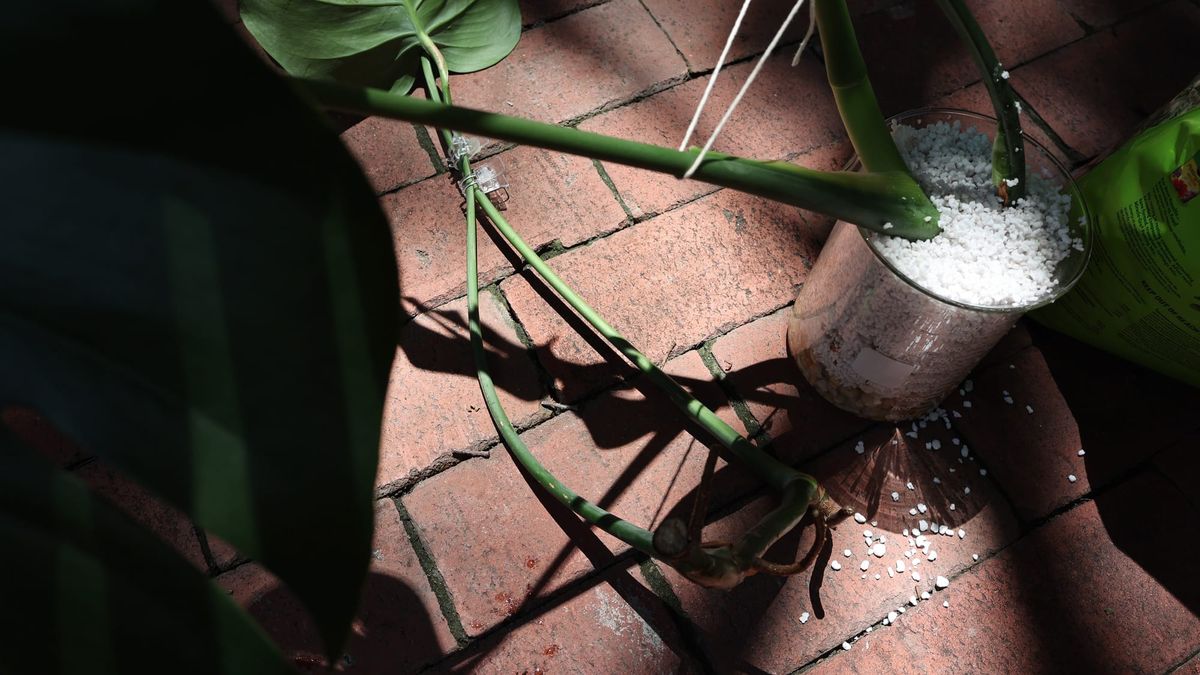
Recently I had cause to purchase a bag of perlite and realized that I had no idea what the stuff was. Perlite is a mineral, which we mine from the ground and then process in different ways for different uses. Agricultural or “expanded” perlite, the kind you might mix into some potting soil or use to root a couple of monstera cuttings, is incredibly light by volume; the eight-quart bag I purchased made similarly-sized bags of potting soil seem positively leaden. I looked it up: “Expanded” perlite has a density of 0.03–0.15 g/cm3, about the same as balsa wood.
It gets this way because we expand it via heating. We mine raw perlite as a grey mineral. It is an amorphous volcanic glass, consisting mostly of silicon dioxide, which is the same stuff I wrote about in last year’s explainer on silica gel. Like silica gel, perlite has a complex internal structure, but in the case of perlite those cavities are fully sealed and contain liquid water, which accounts for a couple percent of perlite’s mass. But when we heat perlite to 850-900°C, the volcanic glass softens, and the water turns to steam, and the entire thing expands rapidly — like a kernel of popcorn. As it expands, perlite’s volume can increase more than tenfold, resulting in the featherweight stuff I bought at the hardware store. It also turns brilliantly white.
If you want me to write more of this kind of thing — the lists, the links, the little technical rabbit holes — the best way to say so is by starting a paid subscription.
- If you think at all about the design of our transportation systems, you really must read (and scroll through the wonderful visuals of) the NYT’s feature on average hood height, and how it has affected (increased!) pedestrian deaths over the past quarter century. I think this is absolutely horrible, but I’m less sure of my reaction to the related news that our ever-growing average vehicle size might result in significantly fewer on-street parking spaces over time.
- Here’s a very nice, short essay by Ben Sinclair, the co-creator of High Maintenance, about his love of New York, and his love of riding a bike in New York, and his (erstwhile) love for smoking weed and riding a bike in New York. I love (present tense!) High Maintenance, and overall found this whole essay highly relatable.
- I enjoyed Seth Rogen’s NYT interview, which includes some pretty great relationship advice and also a healthy, open assessment of the social acceptability of drugs.
- This is just a note to say how much I appreciate the kind words issued to my writing by Matt, at Web Curios, recently.
I’ve been using definite-length tape dispensers a lot recently, sticking lengths of sky blue masking tape on all manner of things around the house. I had inherited one from my grandfather, an old Scotch model, and immediately loved the way its lever felt, and the way the tape shot towards me when I pushed the lever down. The dispenser had lived on or near my workbench for years, but a few months ago I brought it up to the kitchen and since then have fallen in love with it anew. So enamored was I that I bought a second Scotch definite-length tape dispenser, an old M-96, which was missing its tape spool and was discounted as a result. Then I ordered a replacement tape spool, which turned out to be the wrong size, and then I modeled a new spool, and now I am waiting with bated breath for it to arrive here from the 3D print shop.
(Parenthetically, a few other things I’ve acquired recently, from friends: CW&T’s Personal Body Unit Index; Manual Goods’ Mezzanine table legs kit; Current Flow State’s six-foot-long map of the Lower Deschutes River.)

One of the ironies of summer is that lemon prices typically peak during late summer, just when I want to be drinking lemonade. I remembered this when I went to check off “Lemons” from my groceries list the other day: “$0.99/ea,” the label said, and I wrinkled my face up a bit, remembering when they were $0.59/ea a few months ago. “Maybe I’ll get… eight lemons,” I thought to myself, “instead of the dozen or so that I was planning for. Yeah, eight bucks’ worth of lemons, and maybe a dollar or two worth of sugar. That’ll be fine.”
The lemons sat on the counter for a few days, which honestly wasn’t ideal, but eventually I found the bandwidth, and made a batch of lemonade, and wrote it all down for you here:
Oleo Saccharum Lemonade
- Some quantity of lemons
- Some quantity of sugar, preferably caster/superfine
- Pinch of salt
- Water
- First, a note on quantities: Today, as I write this down, I’m working with eight lemons. You should start with however many you happen to have, with the caveat that the recipe is more involved than “juice them and add sugar and water,” and as a result you may find yourself drawn towards batch quantities that will either serve a party, or last a couple days in the fridge. In my house, I usually work with around ten lemons, but as I said, today I’m working with eight.
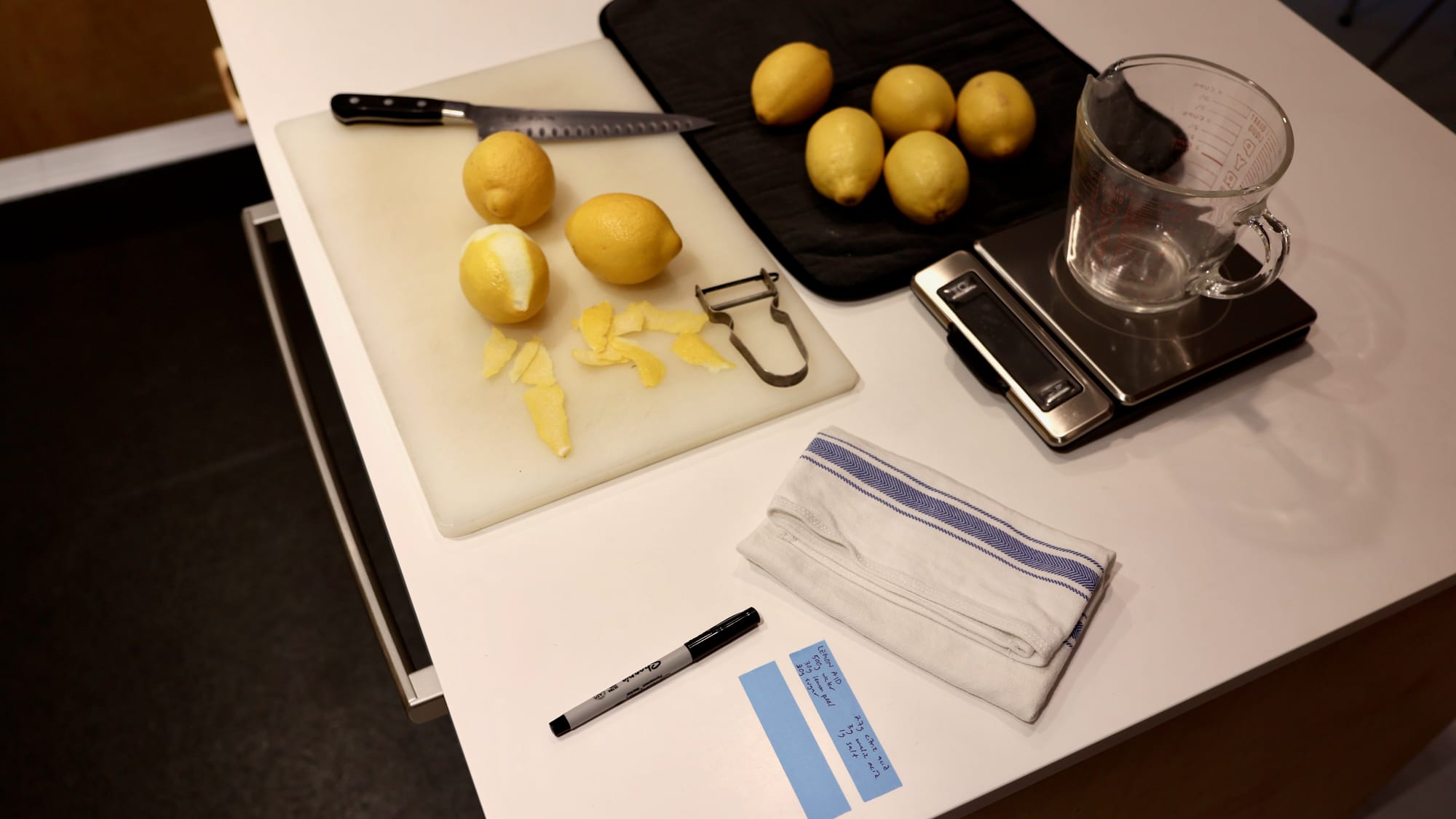
- Peel the zest off of your lemons. Try to only get the yellow part; I find that this is easiest with fresh lemons and (obviously) a sharp cutting implement. I typically use a Y-shaped peeler and work one hemisphere at a time, drawing the peeler from the equator down to one of the poles, then rolling the lemon around its axis a bit and repeating. When one hemisphere is done I flip the lemon around and do the other, and when the entire lemon is zested, I set it aside.
- Roughly chop all of your zest. This increases its surface area, and makes the zest easier to mix with your sugar, and just makes the entire process quicker. I aim for roughly a 5-mm chop, but I don’t do it that carefully.
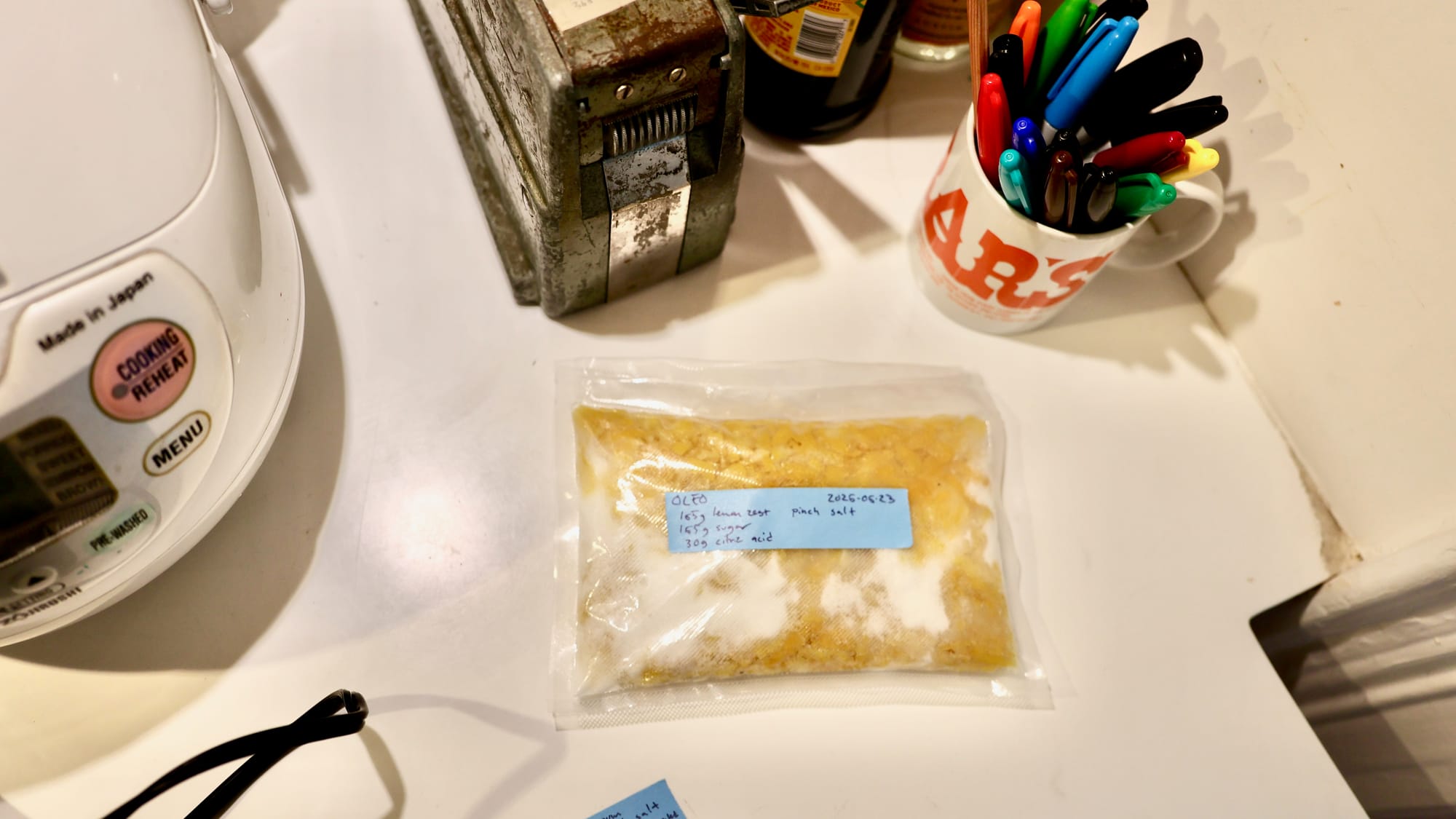
- Weigh your zest — today I got 165 grams — and mix it with an equal weight of sugar; after a few hours this will become your oleo syrup. You can do this in a glass bowl or measuring cup, or if you have a vacuum sealer then you can do it right in the vacuum bag. I bought a vacuum sealer for this purpose, but only after I had made this basic recipe a half dozen times and decided it was worth streamlining a bit. Anyway, you can make your oleo syrup in any nonreactive vessel with (to me) indistinguishable results.
- Add a small pinch of salt for good measure, mix it up a bit, and either vacuum seal the bag closed or put a lid on whatever bowl you’re using. Then let it sit. Come back periodically and give the bag a massage, or the bowl a stir. After a few hours a syrup will develop: The sugar pulls the liquids (including essential oils) out of the zest, and then the sugar dissolves into those liquids.
- While you’re letting your oleo syrup develop, juice your lemons. Strain and weigh; today I got 390 grams of juice.
- Once the oleo syrup is fully syrupy, with no undissolved sugar, I strain and weigh it. Today this took a few hours, and resulted in 222 grams of oleo syrup. I know that I put 165 grams of sugar into the oleo, so I can deduce that I’ve extracted about 48 grams of something from my lemon zest — presumably some combination of oil, and water, and sugar. Wanting to extract as much of this stuff from the zest as possible, I leave the zest in the strainer and pour an additional 165 grams of water over it. Now I have a simple syrup, weighing 378 grams, which contains 165 grams of sugar, 165 grams of water, and 48 grams of flavorful stuff that’s been extracted from lemon zest.
- So, 378 grams of lemon syrup and 390 grams of lemon juice. I mix these, and they weigh 768 grams, and then I add three times as much — 2304 grams — of water.
- And it’s here, finally, that I realize I’ve made way too much lemonade, and in order to mix in the water I need to get a second pitcher, or maybe while I’m at it a third pitcher, and then I end up pouring the lemonade back and forth into all three pitchers in a haphazard attempt to mix it all evenly.
- Eventually I’m done, though, and I taste the stuff, and it’s incredible except for the fact that I’ve also been snacking on little bits of sugary zest, and so my sweet and sour receptors are all messed up. So maybe I take a slug of milk, and eat a couple of blueberries, and then come back to the lemonade. And then I can taste it, this wintertime fruit that I find myself reaching for every year this time.
If you made it this far, thanks for reading.
If you want to support this kind of work, you can become a member.
Thanks as always to everyone who makes SOW possible through their paid subscriptions. Thanks too to Stella Parks for answering my questions about oleo saccharum via email, and to Cara for requesting the oleo saccharum lemonade recipe in a comment a few weeks back.