
Samantha
Maybe I did know his brother
“White Elantra, there she is — Samantha,” I said. I was pointing at the white Elantra driving slowly towards me. Then the white Elantra drove right past me, and I said “Oh — there she goes.”
I had been waiting for Samantha to pick me up for something like seventeen minutes. When she accepted my ride she was to the east of me, and heading further east, on US 1. I needed to go west on US 1, and for a worried moment I thought about canceling the ride. But then she turned around, and I recalculated what time I needed to get to Mystic, and decided that yeah, sure, I could wait for Samantha. I was anxious the entire wait, then relieved to finally see her approaching, then anxious again when she didn’t stop. Then I saw that she was making a U-turn, so that when she pulled up I could get into the passenger-side rear door. I appreciated that, and again decided that Samantha would get me to Mystic on time. Then the car pulled up, and the passenger window rolled down, and there Samantha was — not driving, but sitting in the front passenger seat, her seat reclined so aggressively that neither I, nor my luggage, would fit in the seat behind her.
I didn’t get the name of the guy who was driving the Elantra. This is funny, because after Samantha introduced him, and explained that he was there “for protection,” he proceeded to assume the leading role in our fifteen-minute conversation. By this point I was sitting directly behind him, in the only corner of the back seat that wasn’t covered with Samantha’s — or possibly his — personal belongings. I was surrounded by crap. On the floor to my right, behind Samantha, I saw a reusable polypropylene shopping bag full of what seemed like random junk, and part of a six-pack of twenty-ounce bottles of Dr. Pepper. I had put my bags on the fluffy blue polyester blanket that was strewn across the seat, and had tried to casually brush the blanket out from where I was sitting, but didn’t want to make a big scene out of it. I felt a little trapped. I didn’t want to touch the blanket, but I also didn’t want to know where the blanket was relative to my body. I began to suspect that Samantha hadn’t wanted to pick up any passengers today. She lounged in her bucket seat casually, one plump, pale thigh crossed over the other, waving her phone around as she spoke with humor and mild hostility towards some previous ride-share customers. “We picked someone up the other day and when they saw him— [Samantha waved her phone at the driver] —they said, ‘That’s sketchy.’ And we said ‘Okay, then don’t ride with us.’ And when we drove back past them a half hour later they were still waiting to be picked up by someone else.”
The car smelled of weed vapor, mixed and partially masked by the air freshener hanging from the rear-view mirror. The air freshener was shaped like a pine tree, with a pseudo-celestial scene and the word “SUPERNOVA” printed on it in a generic, space-age font. The driver asked me where I was from, and I told them that I lived in Brooklyn and grew up on Long Island. To this the driver perked up.
“Oh, maybe you know my brother,” he said. “He lives on Long Island.”
I agreed that yeah, maybe I did know his brother, and what was his brother’s name?
“Long Island is a big place to be from,” Samantha chimed in, a little skeptically. “And Manhattan’s a big place to be from too.”
I considered whether I should remind her that I lived in Brooklyn. Then the driver told me his brother’s name, and to my dismay I didn’t know him. “But you’d be surprised,” I told them, wanting to portray the city in a welcoming, tight-knit light. “Now that I’ve lived there so long, the city doesn’t feel so big anymore. And I often find that I have mutual connections with random people I meet there.”
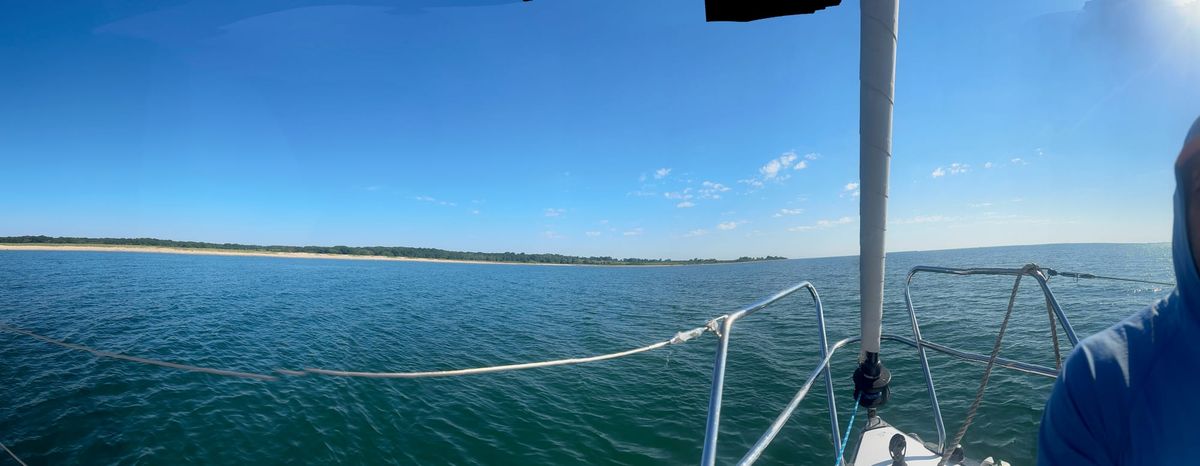
I tried to let my attention drift. I am not obliged to pursue this conversation, I told myself as I gazed out the window. It was sunny, and warm, and it had been breezy all morning on the sail around Fisher’s Island and up to Stonington. I wanted to be feeling carefree, relaxed, leisurely. But in truth I was pretty overwhelmed.
But I didn’t say this aloud, and the driver clearly wanted to talk. “So, are you a Dodgers fan or a Yankees fan,” he asked me in an almost accusatorial tone.
The Dodgers moved out of Brooklyn in 1957, twenty-six years before I was born. “I live about a mile from where Ebbets field was,” I replied, “but I grew up a Mets fan.”
They cheered, and I took that to mean that either they were also Mets fans, or they just hated the Yankees. Either way, I figured that they would remember the 2000 World Series, when Roger Clemens threw the splintered barrel of a bat at Mike Piazza, who had been trotting slowly towards first after hitting a broken-bat foul ball. This event — and the fact that Clemens wasn’t ejected, and went on to pitch eight shutout innings, helping the Yankees win the series in five games — had utterly broken my heart when it occurred. I was a senior in high school at the time, and for some reason that World Series loss seemed to underscore how out-of-place I was in New York. A few months later I would decline a small scholarship from NYU and opt instead to pay full tuition, at the out-of-state rate, at the University of California at Santa Cruz.
“But I can’t follow the Mets too closely anymore,” I told the driver. “The 2000 World Series was just too much for me, you know?”
He nodded politely, so I added, “you know, when Clemens threw the bat at Piazza.”
“A bat would hurt a lot more than a ball,” the driver replied, and I decided that he probably didn’t know what I was talking about. So I just laughed, and agreed with him, and let it drop.
I glanced around the car. There was a piece of mail — a bill or something — in the door pocket next to me. The Elantra’s entertainment console showed its clunky default menu screen. I looked around for clues about who these people were to each other, but came up empty. At one point the driver, whose ponytailed hair was grey, patted the much-younger Samantha’s leg in an ambiguous way. He was telling me excitedly about an Italian sandwich shop that I had to go to. It was in White Plains, a town in Westchester that’s about an hour-and-a-half from me by train. “I’m trying to get her to go there too,” he said, touching Samantha’s folded knee hopefully. Apparently the sandwich shop’s owner, a YouTuber, pronounced “sandwich” like san-WEETCH. I chuckled and told him that I’d check it out. At this point Samantha started talking to the driver about someone who they would be seeing later in the day at an unspecified birthday party. “She’s fancy,” the driver said. “She goes to places that cost twenty-five bucks a person.”
I thought about my appearance: the white-and-blue striped Oxford shirt, the vintage Wayfarers, the dad sneakers, the sporty, neon pink-and-blue backpack. I thought about how they had picked me up at a marina, fresh off of a three-day sailing trip. On the trip’s first night, we had anchored in the public water on the east side of Gardiner’s Island, which is privately owned and totally serene. After we anchored I jumped off the bow of the boat, swimming aimlessly for ten or fifteen minutes in the salty bay. Then I hoisted myself back aboard, and jumped off again, this time off of the starboard side of the boat, which meant clearing the life lines, which always freaks me out a bit. I went feet-first both jumps, and each time I hit the water my left foot hurt, and then my dad said something about diving head-first and I thought yeah, of course, I should be diving head-first. Then I got back out of the water and grilled a half-dozen milky white sea scallops on the charcoal grill hanging off the boat’s stern.
“You a stoner, Spencer?” the driver asked me, his voice curling upward with genuine curiosity. It was at this point that I noted the laconic pace of both the driver’s and Samantha’s questions. They were definitely the most chill people I had been in a car with for a while.
“Yeah,” I laughed back at them. “Sure,” I said.
We pulled into the train station at four PM sharp, the July sun’s intensity just past its peak. I thanked them as I got out of the car and gathered my stuff, but once I was alone I found myself deeply frazzled, preoccupied about the conversation that awaited me back in the city.
At the train station I sat in the shade and took deep breaths. I put my earbuds in, browsed for some music to listen to, and then took the earbuds back out and just sat there, thinking, trying to calm myself down. When the train arrived I got on and took the first seat I found. The seat was next to a beautiful woman with bobbed dirty-blonde hair. She was knitting, and listening to a podcast, and periodically texting someone. I took my sunglasses off, and put on my eyeglasses, and finished reading an essay by Sheila Heti about a series of psychedelic therapy sessions she had done. The train ride back to the city lasted about three hours, and for almost the entire ride my awareness of the woman next to me was heightened. I thought to myself, “I’m acting naturally,” but when I imagined how she might see me it was like I was a caricature of something. Every once in a while I noticed her looking up from her knitting to observe the passing Connecticut countryside, and every time I looked up too, trying urgently to understand what it was that she saw out there.
Hey, it's Spencer.
Thank you for reading this. I spend a lot of effort trying to notice and write down moments like this one, and it means a great deal to me that you're willing to spend time with my work.
If you'd like to support Scope of Work and make essays like this possible, I'd be grateful if you considered becoming a paid subscriber. Your support is what allows me to keep reporting, writing, and publishing independently.